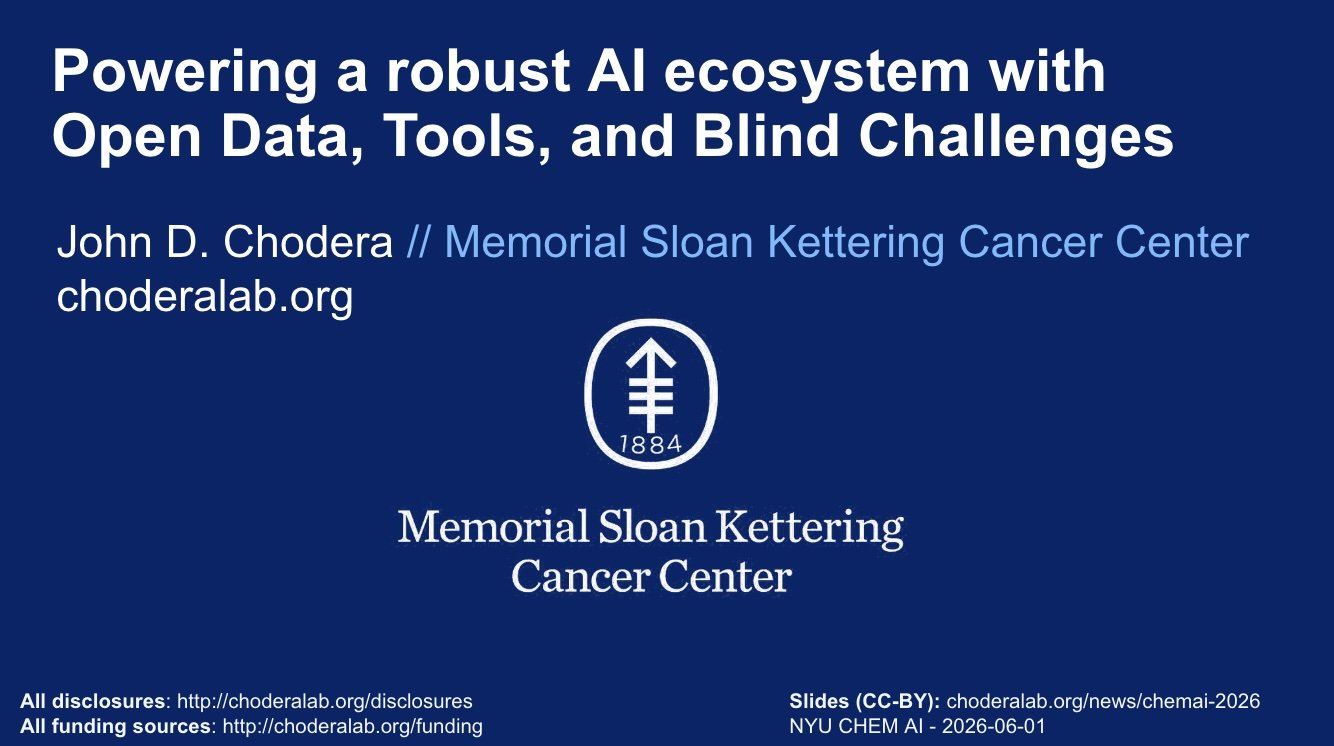
Slides from John Chodera's talk at MolSSI Workshop on Machine Learning in Chemistry
/You can find the slides from John Chodera’s talk at the MolSSI Workshop on Machine Learning in Chemistry at the University of Maryland here: [PDF]

You can find the slides from John Chodera’s talk at the MolSSI Workshop on Machine Learning in Chemistry at the University of Maryland here: [PDF]

I was thrilled to have had the opportunity to speak at the 15th German Conference on Cheminformatics (GCC 2019) in Mainz! You can find a PDF version of my slides here: [PDF] [reduced size PDF]
I’m also tremendously excited that GCC 2020 will take place 1-5 Nov 2020 and will feature two days of EuroSAMPL, our first international SAMPL challenges meeting! Stay tuned for more information.

John Chodera gave the keynote talk (“Redesigning Drug Design (Together)”) at the Mid Atlantic Computational Chemistry (MACC) / New York Area Group for Informatics and Modeling (NYAGIM) joint Symposium at WCMC on 26 Apr 2019! You can find the slides from that talk here: [DOI]

The Chodera lab turns six years old on 1 Nov 2018! It’s been an exciting six years, having submitted or published thirty-five papers and having twenty-four trainees pass into or through the lab since then. To celebrate, John Chodera was asked to give a Sloan Kettering Institute (SKI) talk highlighting some of the exciting accomplishments and future directions. You can find the video of the whole talk here: [YouTube] [PDF Slides]
Check out more videos at the Chodera lab YouTube Channel.

I'm excited to attend OpenEye MIniCUP in Boston to talk about our work on building scalable open source software for exploring technological innovations in free energy calculations in the cloud! You can find a copy of the slides I presented here: [PDF]

Postdoc Levi Naden gave a Hot Topics presentation this week on tips and techniques for making better plots with less code using the powerful matplotlib Python plotting library. Several people have already asked for copies of the slides, so here they are! [Slides PDF]
I had the great pleasure of being the final speaker at OpenEye's ever-stimulating CUP meeting in Santa Fe, NM, now in its 17th year. David Mobley and I were able to demonstrate the ease by which hydration free energies could be computed on GPUs in the cloud using open source tools.
Many people requested a copy of my slides, so here they are! [PDF]

I had a fantastic time visiting the computational chemists at GSK in Collegeville, PA. Here are my talk slides from that visit.

Slides for my talk at the CCPBioSim Free Energy Calculation and Kinetics Workshop at Kings College London are available here.
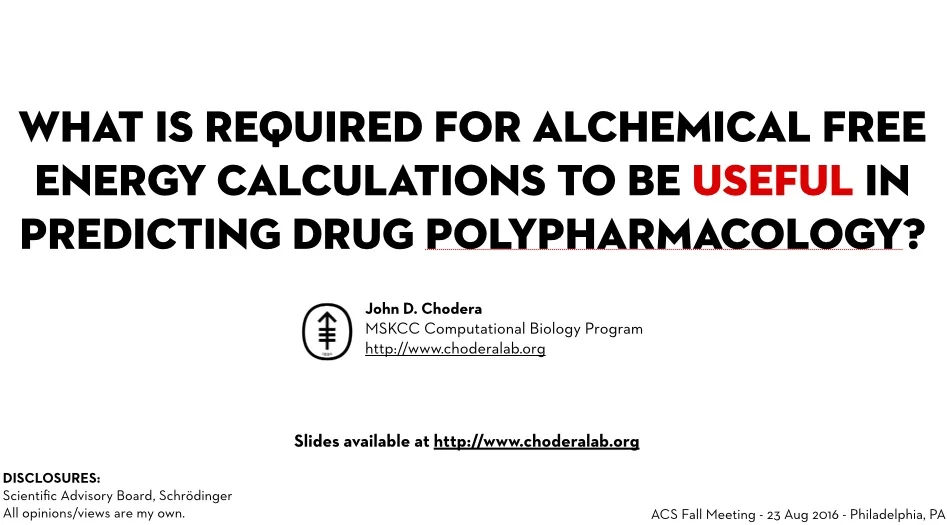
Slides for my talk for the ACS Philadelphia session on polypharmacology can be found here: PDF

The slides for my talk in the afternoon ACS Philadelphia session on Sharing Pharmaceutical Industry Data are available here: PDF

Postdoc Dr. Sonya Hanson gave a public talk at Genspace on Thu 17 Mar about how computer programs can help us design better cancer drugs. Genspace will post a video of the talk online soon, but here are the slides to tide you over til then. Thanks, Genspace, for a great night!
Slides from my talk are available here!

The International Centre for Mathematical Sciences (ICMS) held a fantastic workshop over the last week here in Edinburgh, covering multiscale methods for stochastic dynamical systems in biology. It's phenomenal that there are organizations that are strongly committed to supporting the exciting interface between mathematics and the biological sciences, and the enthusiastic discussions at this meeting were a reflection of the enormous potential that work at this interface holds for both fields. These workshops also attempt to engage the public to communicate the importance of this interdisciplinary work through a public lecture series, with Sarah A. Harris delivering a talk on the interface of physics and biology.
PDF slides from my talk are available online, and the talks were all recorded to be posted online shortly.

I am thrilled to have had the opportunity to speak at the GTC 11th Protein Kinases and Drug Discovery meeting. This was a small, but highly focused meeting with a number of superstars from the kinase field (including Susan Taylor!).
For those that were interested, here is a copy of my talk slides.

I'm excited to be able to visit the Bio/Nano group at Autodesk in San Francisco's lovely Pier 9 area today!
Talk slides are available: PDF

I'm thrilled to have the opportunity to speak to a distinguished collection of scientists from pharma and academia here in Tokyo at the OpenEye JCUP VI drug discovery meeting.
I thought it might help to post a PDF copy of my slides where I discuss how experiments and theory can work together to gain insight into how to improve quantitative predictive models for drug discovery.
Four members of the Chodera lab will be headed to the Feb 7-11 Biophysical Society Meeting in Baltimore, MD!
Postdocs Sonya Hanson and Kyle Beauchamp will both be giving talks:

In addition, Sonya Hanson will serve as an official guest blogger for the BPS 2015 meeting! Be sure to tune into the official BPS Blog to follow along!
Talk slides will be posted after the conference.
Rumor has it the lab will also make a brief appearance at the Society for Laboratory Automation and Screening SLAS2015 conference in Washington DC.

I had a fantastic time hearing about all of the exciting science going on in NY at the New York Structural Biology Discussion Group 10th Winter Meeting hosted at the New York Academy of Sciences last week. I had several requests to make my talk slides available, so I'm posting them here in PDF form:
John Chodera's talk slides from the NYSBDG meeting on Wed 21 Jan
Looking forward to many great future meetings of the NYSBDG!
Postdoc Kyle Beaucamp gave a talk about our omnia.md Python stack for biophysical computation at PyData NYC 2014. The whole talk is now available online:

Youtube link:
https://www.youtube.com/watch?v=MBH2qrwRhEE
Slides for the talk can be found here:
https://github.com/omnia-md/PyData2014
Abstract:
Engineering new therapeutics is hard--and getting harder. Accurate physical modeling promises to improve the way we design drugs, but the necessary open source infrastructure is lacking. The Omnia Consortium---a collaboration of multiple academic laboratories working on physical modeling tools for drug discovery---is producing a suite of open-source tools for understanding drugs, proteins, and the biomolecular mechanisms of disease. Our Python-centric software stack is uses Python, Cython, C++, and CUDA/OpenCL to achieve bleeding-edge performance. Part of our stack (OpenMM) is also implemented on the Folding@Home distributed computing project and currently runs on tens of thousands of high-end GPUs around the world, producing over 18PFLOP/s of computational power. In our talk, we will introduce biophysical simulation and its application to understanding mechanisms of disease and its potential for designing new therapeutics. We will discuss the challenges in building robust tools for automating and scaling up biophysical simulations, compared with the relatively mature tools already available for modern data science. We will describe some of the tools in our stack (OpenMM, MDTraj, MSMBuilder, Yank) and how we use the conda packaging environment to facilitate distribution of our domain-specific code. Finally, we will discuss our plans to improve physical models and study drug resistance using iterative cycles of modeling and automated biophysical experiments performed at Memorial Sloan-Kettering Cancer Center.
The Chodera lab at the Memorial Sloan-Kettering Cancer Center
RECENT PUBLICATIONS
RECENT NEWS
RECENT TWEETS